Tuesday, 24 April 2012

Media and Gender/Race Stereotypes

Film: Xmen's Weak Storm
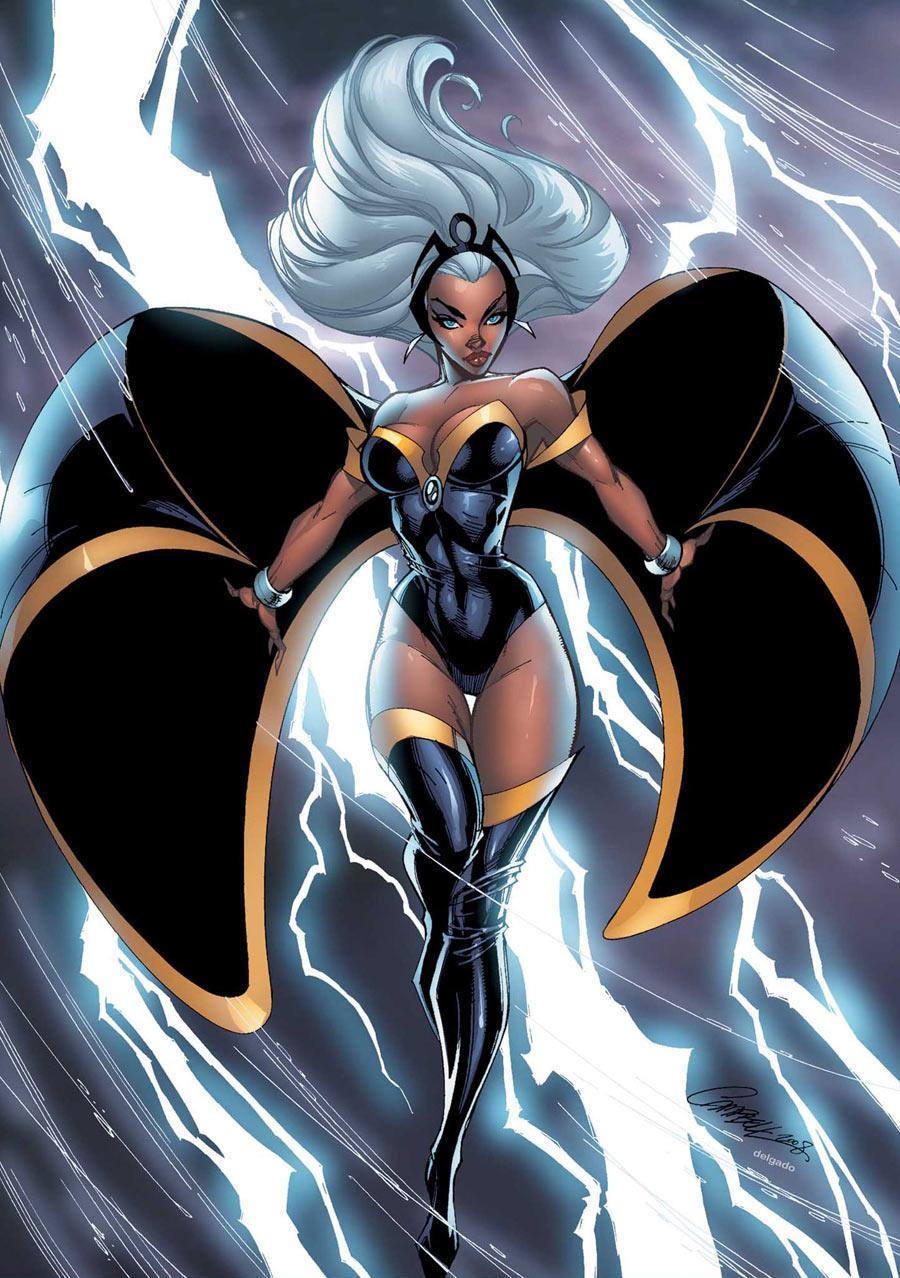
I came out of the latest installment of the X-Men movie series, “The Last Stand,” like most fans of the comic book: deeply disappointed. Some were upset by the limited screen time of aficionado favorites like Angel (precursor to Archangel), while others lamented the two dimensional vilification of Magneto, X-Men antagonist and leader for mutant self determination. My own issue has been smoldering over the entire series – the disempowerment and basic all around “girlification” of X-Men leader Storm.
Why would filmmakers cast the coquettish Berry to play the fierce and dominating Storm in the first place? Given the fact that the film was put out by Fox, one might suspect the worst. However, one can only surmise that the filmmakers lacked the imagination to get beyond the bankable Berry, thinking they needed to tone down the only Black heroine to star in a major comic book franchise. And that’s too bad.

The comic book Storm’s cold blooded, self-assured fearlessness conjures up more of a Grace Jones or Angela Bassett than the cowering, wimpy character Berry brings to the screen. According to a recent interview, Berry expressed concern about the role saying she hoped to do more than ‘go get the plane’ in the trilogy’s final installment (Washington Post, “Halle Storm,” May 27, 2006).

Storm’s character was a bright spot in the relentless denigration of Black women in media. Her character operated as a strong metaphor for what it means to be a Black woman in the United States. In Africa, she was revered as a goddess and a queen. In the United States she faces fear and bigotry but she remains tough, unapologetic, strong; a warrior in every sense of the word.

 I've always viewed Storm as a queen and Wolverine as an unruly warrior or animal. When in the film, its the other way round. She always seems to be behind the manly hunky Wolverine, like he's in charge...

http://www.seeingblack.com/article_50.shtml

Media and Gender Stereotypes

Course, this is a primary example of gendered stereotypes and how the media upholds them by infusing our homes with them. Imagine how many of these commercials play in between our daily consumption of TV shows, and how many of these gender constructions invade the impressionable minds of our children.

The last minute is most interesting

http://marinagraphy.com/media-gender-stereotypes/

Gender stereotypes - History of Pink and Blue


Did you know that pink hasn’t always been a colour for girls, or blue for boys?
In Michael Kimmel’s outstanding Manhood in America: A Cultural History, he points out that clothing wasn’t colour-coded in America until the early twentieth century, before which little boys and girls were dressed pretty much identically. Even when people started pushing for more gender-specific children’s clothing, there was a huge debate over which colour to assign to which gender. It started out with boys wearing pink or red because the colours were seen to indicate strength, while girls wore blue because they were “flighty” like the sky.

http://www.gender-focus.com/2010/09/23/pink-for-girls/

Stereotypes and sexuality - not falling into one category

"The Stroke Had Turned Me Gay"

Rugby player who had stroke woke up gay and became hairdresser Playing to the stereotypes:

Looking at past pictures of himself, 27-year-old Chris Birch struggles to remember or identify with his old self. He used to be a 19-stone, beer-swilling, party-loving rugby fan from the Welsh valleys, the life and soul of a party. He worked in a bank and loved sport and motorbikes.
After a freak accident in 2011, he says he underwent a big change to his personality. He believes that he has gone from being straight to gay. There are few known cases of a stroke turning a straight person gay, and major personality changes in stroke sufferers are rare. Even Jak Powell, Birch's fiance, believes his partner may always have been gay.
Dr Qazi Rahman of Queen Mary, University of London, an expert in human sexual orientation, invited Birch, who has swapped banking for hairdressing, to undergo the computer-based tests to see if he may, indeed, have been born gay. On half of the tests, Birch performed in the "expected direction" for a gay man, and for the other half was within the range of a straight man.
"Sometimes it takes something like a neurological insult - which is what a stroke is - to make you reassess those feelings, perhaps that are lying dormant, and bring them into the front of your mind and it is possible that is what has happened with [Birch]."

This teaches us a lot about attitudes to sexuality.

What the man 'turned' gay by a stroke can teach us about attitudes to sexuality | Paul Flynn


"Gregory Gorgeous"


Another person who plays to stereotypes is Gregory Gorgeous who is the extreme stereotypical gay.
http://www.youtube.com/user/GregoryGORGEOUS
With videos like 'whats in my purse', he looks and acts extremely feminine. In my experience, the really camp ones get more camp and become more of the stereotypical gay in front of others, such as friends. But if its just you and them, chilling, they are still camp but not so O.T.T.

He also makes me question gender stereotypes. Is he seen as a weaker person now because he looks feminine? If he was to look more masculine facially and clothes-wise (with the same body mass etc.) would he be seen as stronger?


Gareth Thomas - a gay rugby player? Yes!


Gareth Thomas (rugby player).jpgFormer Wales and Lions captain Gareth Thomas has broken one of the major taboos that surround sport by revealing he is gay.
"Just because you are gay, it doesn't mean you fancy every man who walks the planet," Thomas told the Daily Mail. "I don't want to be known as a gay rugby player. I am a rugby player first and foremost. I am a man."
"I just happen to be gay," he added. "It's irrelevant.
"What I choose to do when I close the door at home has nothing to do with what I have achieved in rugby.
"I'd love for it, in 10 years' time, not to even be an issue in sport, and for people to say: 'So what?'"
So they do exist ..you can be a 19-stone, beer-swilling, party-loving rugby fan from the Welsh valleys, the life and soul of a party,  worked in a bank and loved sport and motorbikes ...and be gay!

http://news.bbc.co.uk/sport1/hi/rugby_union/welsh/8421956.stm

Monday, 23 April 2012

Imagery which doesn't just fall into one category

Though classed as Illustrations, there is something I noticed about the majority of Harry Potter and the Deathly Hallow Part2 posters. I couldn't figure out whether they were photography or design like photorealism. Maybe its a mix of both?
CGI maybe?

This would be very good for something which was once a book. Without the illustrations and imagination and writing of harry potter, the films would not exist.
It keeps a bit of the orginal book and imagination.

Comic books made into films should keep a part of its original format at least on the poster or DVD cover, rather than changing it entirely.
So for example, with the marvel films it would be cool if they could look slightly comic arty and less 'lets pose for the camera' like a lot of the film posters are.

Illustrator - Matthew Woodson

Personal work 2007-2008
Matthew Woodson was born and raised in the pit of snakes known as rural Southern Indiana. After graduating from The School of The Art Institute of Chicago in early 2006 with a focus in Natural History Illustration, Matthew’s obsessive loves for natural history and the past were stronger then they had ever been. Fresh out of school Matthew was commissioned by Margeotes, Fertitta & Partners New York to illustrate the Perry Ellis Fall/Winter 2006 campaign, and has been working as a fulltime freelance illustrator ever since.
Looks a bit like a graphic novel/comic artist.
http://www.ghostco.org/

Comic artists use photorealism

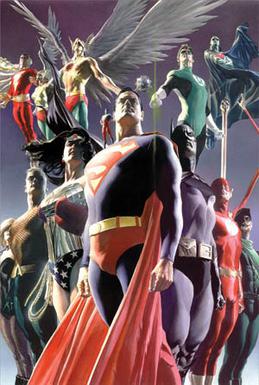
Comics Wallpaper: Uncanny X-Men (by Alex Ross)Alex Ross is an american comic book writer/artist known for his painted interiors, covers and design work.  He rose to fame with the 1994 mini series Marvels which he collaborated with the writer Kurt Busiek for Marvel Comics. He has done projects for both Marvel and DC Comics, including the 1996 Kingdom Come. His feature film work includes concept and narrative art for Spider-Man and Spider-Man 2, and DVD packaging art for the M.

Andreas Englund

Taken from his website:
Andreas Englund - Garage
Garage
"Humour can be the carrier of messages that are
otherwise hard to convey.
For me, it liberates my thoughts and ideas from
pretentiousness while at the same time it opens
doors to new routes and angles."

Artist Andreas Englund was born
1974 in Falun, Sweden.
Now he works and lives in Stockholm.

A series of work which he is most famous for is the aging superhero which bares a resemblance to The Punisher.


Photorealism - Glennray Tutor

Patrick Caulfield uses Photorealism.
Photorealism is the genre of painting, based on the use of photography to gather information, which is then used to create a painting that appears photographic. The term is primarily applied to paintings from the US art movement that began in the late 1960s and early 1970s.
Evolved from Pop Art and a reaction to Abstract expressionism and minimalism (against the last two).
Dream of Love 2005
I love the use of bright colours so it would make sense to look at an artist called Glennray Tutor. He (born in Kennett, Missouri in 1950) is an American painter who is known for his photorealistic paintings. He is considered to be part of the Photorealism art movement. His paintings are immersed with bright colours, nostalgic iterms, metaphor and with a complete focus on detail.

Glennray Tutor has also illustrated a few book covers in his time. Books by Michael Bishop which can be described as fantasy pieces.
Fantasy is something which I am looking into with the media codes and conventions for this particular genre.